Production Flow
The Funnel Effect in Production
Why production output is always constrained by the weakest step in the process, and what manufacturers can do to create smoother, more balanced flow.
Introduction
The funnel effect is a core production concept that explains why increasing input or effort does not always create higher output. It appears when different stages of a process operate at different capacities, creating imbalances that lower overall efficiency. This is especially important in manufacturing environments, where multiple operations must work together in a coordinated flow.
Understanding the Funnel Effect
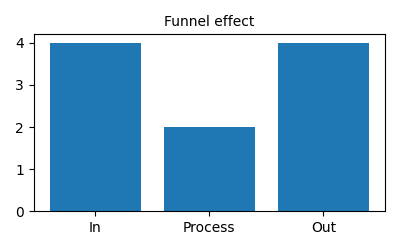
In any production system, total output is determined by the slowest operation, often called the bottleneck. Even if earlier stages can produce more, the system as a whole cannot exceed the capacity of that limiting step. The extra work accumulates before the bottleneck, creating congestion and inefficiency.
This is why the process resembles a funnel: wide at the top, where input can be added freely, and narrow at the bottom, where output is restricted. No matter how much work enters the system, final output remains limited by the narrowest point.
A Practical Example
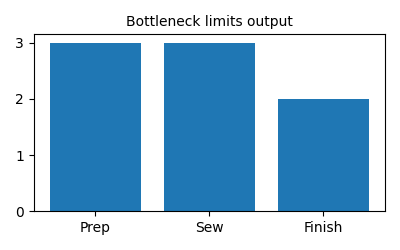
Consider a production line with preparation, sewing, and finishing. If the first two stages can each produce three units per day, but finishing can only complete two, the total output of the line is still only two units per day. The extra unit produced upstream does not become finished goods. Instead, it turns into work-in-progress inventory.
This unfinished stock ties up capital, increases lead times, and can create the illusion of productivity without creating real value.
Common Misconceptions and Ineffective Solutions
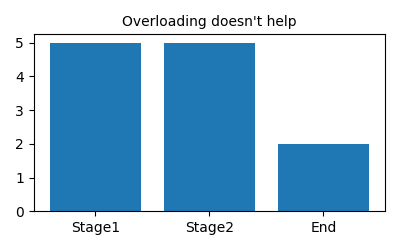
A common reaction to low output is to push more work into the system or add more workers. But if the bottleneck is unchanged, output does not improve in a sustainable way. The imbalance only becomes more visible.
Some organizations respond by temporarily reallocating workers to the bottleneck area. While this can help in the short term, it often reflects weak planning rather than real process improvement. Without clear capacity data and accurate time standards, fixing one bottleneck may simply create another elsewhere.
The Role of Time Standards (SAM)
Standard Allowed Minutes (SAM) are essential for effective production management. SAM defines the time required to complete each operation under normal conditions. Accurate time standards support realistic planning, fair target setting, and better line balancing.
When SAM values are missing or incorrect, companies risk pricing orders inaccurately, underestimating delivery times, and misreading worker performance. In those cases, planning errors are often mistaken for operator problems.
From Funnel to Balanced Flow
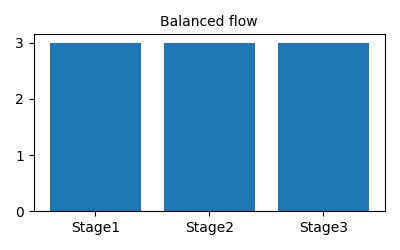
The goal of an efficient production system is to reduce the funnel effect and move toward balanced flow. In an ideal state, each stage operates at a similar capacity, so work passes smoothly from one step to the next without delay or accumulation. Perfect balance is rare, but continuous monitoring and incremental adjustments can significantly improve overall performance.
Standardization and Continuous Improvement
Modern production systems often use methodologies such as Predetermined Motion Time Systems (PMTS) to support standardization. These approaches define precise movements and associated times, reduce variability, and remove subjectivity from task evaluation. With standardized methods, organizations can identify inefficiencies more clearly, optimize workflows, and maintain more consistent performance.
Conclusion
The funnel effect highlights a simple but powerful truth: increasing input does not guarantee higher output. Sustainable efficiency comes from understanding constraints, balancing workloads, and applying accurate time standards. Manufacturers who focus on these fundamentals are in a stronger position to improve productivity and maintain stable performance over time.
Based on an article by Bela Marthi.